Source code for Hardware.Microcontroller
  1"""Serial interface for MCU-mediated FPGA measurement.
  2
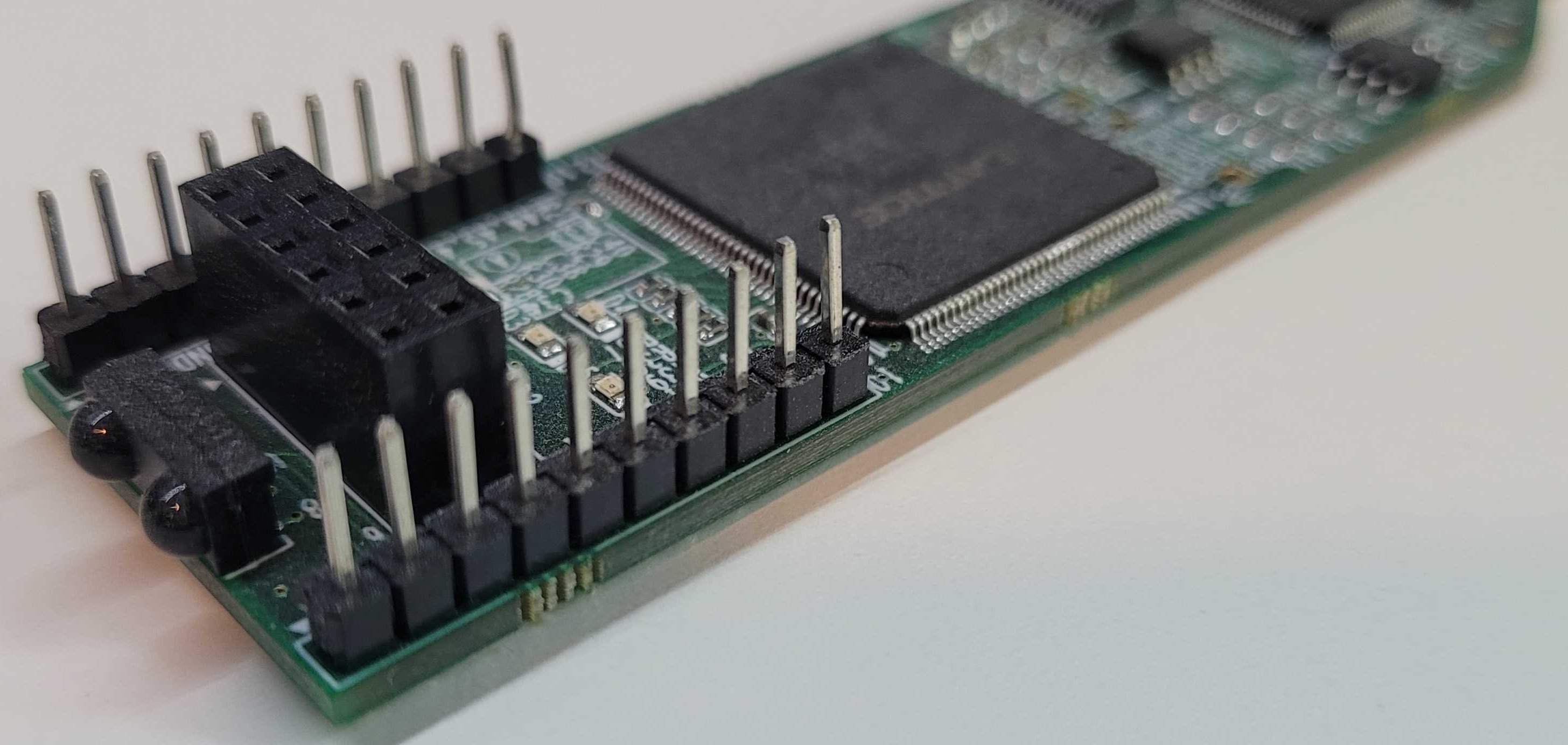
  3Provides the ``Microcontroller`` class that communicates with a
  4microcontroller over a serial link to program an ICE40 FPGA and
  5retrieve fitness-evaluation data (pulse counts or ADC waveforms).
  6
  7.. note:: Serial protocol details were inferred from code and may need
  8   verification against MCU firmware.
  9"""
 10
 11from dataclasses import dataclass
 12from time import time
 13from serial import Serial
 14from BitstreamEvolutionProtocols import Circuit, DataRequest, FPGA_Compilation_Data, FPGA_Model, Measurement
 15from Logger import Logger
 16from returns.result import Success, Failure # type: ignore
 17

[docs]
 18@dataclass
 19class MicrocontrollerConfig:
 20    """Serial connection parameters for the MCU.
 21
 22    Attributes
 23    ----------
 24    usb_path : str
 25        Device path to the serial port (e.g. ``/dev/ttyUSB0``).
 26    serial_baud : int
 27        Baud rate for the serial connection.
 28    read_timeout : float
 29        Timeout in seconds for serial read operations.
 30    """
 31
 32    usb_path: str
 33    serial_baud: int
 34    read_timeout: float

 35

[docs]
 36class Microcontroller:
 37    """Driver for a serial-connected MCU that programs and reads from an FPGA.
 38
 39    Opens a persistent serial connection on construction and provides
 40    async methods to request waveform or pulse-count measurements.
 41
 42    Concurrency note:
 43    =================
 44    The async methods in this class use blocking pyserial calls and do NOT yield
 45    to the event loop. As a result, asyncio.gather() over multiple Microcontroller
 46    instances currently runs them sequentially, not in parallel.
 47
 48    TODO: Migrate serial I/O to serial_asyncio (https://pypi.org/project/serial-asyncio/)
 49    so that serial reads genuinely suspend and allow other coroutines to run. This is
 50    the server-side component — when the architecture moves to a server-client model,
 51    this class (or its replacement) will run on the server and use serial_asyncio.
 52
 53    Per-Icestick exclusivity:
 54    =========================
 55    Each Microcontroller instance manages exactly one Icestick via one serial port.
 56    iceprog holds exclusive USB access to the device during compile(). Concurrent
 57    calls to request_measurement() on the SAME Microcontroller instance will corrupt
 58    each other. The server must serialize calls per-instance (e.g. one
 59    asyncio.Semaphore(1) per Microcontroller, or a dedicated worker coroutine per
 60    device). Calls on DIFFERENT Microcontroller instances (different Icesticks) can
 61    run concurrently. See .claude/docs/hardware_concurrency.md.
 62    """
 63

[docs]
 64    def __init__(self, fpga: str, logger: Logger, config: MicrocontrollerConfig):
 65        """Initialize the serial connection to the MCU.
 66
 67        Parameters
 68        ----------
 69        fpga : str
 70            FPGA device identifier passed to ``icepack``/``iceprog``.
 71        logger : Logger
 72            Logger instance for event and warning messages.
 73        config : MicrocontrollerConfig
 74            Serial port settings.
 75        """
 76        self.__fpga = fpga
 77        self.__logger = logger
 78        self.__config = config
 79        self.__logger.log_event(1, "MCU SETTINGS ================================", config.usb_path, config.serial_baud)
 80        self.__serial =  Serial(
 81            config.usb_path,
 82            config.serial_baud,
 83            timeout=config.read_timeout
 84        )
 85        self.__serial.dtr = False

 86

[docs]
 87    async def request_measurement(self, measurement: Measurement) -> Measurement:
 88        """Compile the circuit and perform the requested measurement.
 89
 90        Dispatches to ``measure_signal`` or ``measure_pulses`` based on
 91        ``measurement.data_request``.  The result (or error) is stored in
 92        ``measurement.result`` as a ``Success`` or ``Failure``.
 93
 94        Parameters
 95        ----------
 96        measurement : Measurement
 97            Measurement descriptor specifying circuit and data type.
 98
 99        Returns
100        -------
101        Measurement
102            The same object with ``result`` populated.
103        """
104        ckt: Circuit = measurement.circuit
105        fpga_data = FPGA_Compilation_Data(FPGA_Model.ICE40, self.__fpga)
106        if measurement.data_request == DataRequest.WAVEFORM:
107            ckt.compile(fpga_data)
108            try:
109                waveform = await self.measure_signal()
110                measurement.result = Success(waveform)
111            except Exception as e:
112                measurement.result = Failure(e)
113        elif measurement.data_request == DataRequest.OSCILLATIONS:
114            ckt.compile(fpga_data)
115            try:
116                data = await self.measure_pulses(measurement.num_samples)
117                measurement.result = Success(data)
118            except Exception as e:
119                measurement.result = Failure(e)
120        # TODO: elif cases for other measurement types...
121        return measurement

122

[docs]
123    def get_available_FPGAs(self) -> list[str]:
124        """Return the list of FPGA device identifiers managed by this MCU."""
125        return [self.__fpga]

126

[docs]
127    async def measure_signal(self) -> list[int]:
128        """Capture an ADC waveform from the FPGA via the MCU.
129
130        Sends command ``'2'`` to initiate ADC capture, then reads
131        lines between ``START`` and ``FINISHED`` delimiters.
132
133        Returns
134        -------
135        list[int]
136            Integer ADC samples (~10 us apart).
137        """
138        buf = []
139
140        self.__serial.reset_input_buffer()
141        self.__serial.reset_output_buffer()
142        self.__logger.log_event(1, "Reading microcontroller.")
143        # The MCU is expecting a string '2' to initiate the ADC capture from the FPGA (waveform as opposed to pulses)
144        self.__serial.write(b'2')
145        line = self.__serial.read()
146
147        start = time()
148
149        # The MCU returns a START line followed by many lines of data (500 currently) followed by a FINISHED line
150        while b"START\n" not in line:
151            self.__serial.write(b'2')
152            line = self.__serial.read_until()
153
154            if (time() - start) >= self.__config.read_timeout:
155                self.__logger.log_warning(1, "Did not read START from MCU")
156                self.__logger.log_warning(1, "Time Exceeded. Halting MCU Reading.")
157                break
158
159        # TODO  This whole section can probably be optimized
160        # Reads in samples from MCU, with each being 10microseconds apart
161        while (b"FINISHED\n" not in line):
162            line = self.__serial.read_until()
163            if line != b"\n" and line != b"START\n" and line != b"FINISHED\n" and line != b"FINISHED\n":
164                buf.append(line)
165            if (time() - start) >= self.__config.read_timeout:
166                self.__logger.log_warning(1, "Time Exceeded. Halting MCU Reading.")
167                break
168
169        self.__logger.log_event(2, "Finished reading microcontroller. Logging data to file.")
170
171        waveform: list[int] = []
172        for i in buf:
173            if b"FINISHED" not in i:
174                waveform.append(int(i))
175
176        self.__logger.log_event(2, "Completed reading waveform")
177        return waveform

178

[docs]
179    async def measure_pulses(self, samples: int) -> list[int]:
180        """Collect multiple pulse-count samples from the FPGA.
181
182        Parameters
183        ----------
184        samples : int
185            Number of times to call ``measure_pulses_once``.
186
187        Returns
188        -------
189        list[int]
190            Concatenated pulse counts from all sample rounds.
191        """
192        result = []
193        for i in range(samples):
194            result.extend(await self.measure_pulses_once())
195        return result

196

[docs]
197    async def measure_pulses_once(self) -> list[int]:
198        """Perform a single pulse-count read from the MCU.
199
200        Sends command ``'1'`` and polls the serial line for a numeric
201        response, retrying up to 5 times on timeout.  Returns ``-1``
202        on timeout and ``-2`` on parse failure.
203
204        Returns
205        -------
206        list[int]
207            Parsed pulse count(s) from a single read cycle.
208        """
209        buf = []
210        # Poll serial line until START signal
211        self.__logger.log_event(3, f"Starting loop for reading")
212
213        self.__serial.reset_input_buffer()
214        self.__serial.reset_output_buffer()
215        # NOTE The MCU is expecting a string '1' if fitness isn't measured this may be why
216        self.__serial.write(b'1')
217        start = time()
218        self.__logger.log_event(3, f"Starting MCU loop...")
219
220        max_attempts = 5
221        attempts = 0
222        while True:
223            attempts = attempts + 1
224            self.__logger.log_event(3, f"Serial reading...")
225            p = self.__serial.read_until()
226            self.__logger.log_event(3, f"Serial read done")
227            if (time() - start) >= self.__config.read_timeout:
228                self.__logger.log_warning(1, f"Time Exceeded")
229                if attempts >= max_attempts:
230                    self.__logger.log_warning(3, f"Exceeded max attempts ({max_attempts}). Halting MCU reading")
231                    buf.append(-1)
232                    break
233            # TODO We should be able to do whatever this line does better
234            # This is currently doing a poor job at REGEXing the MCU serial return - can be done better
235            # It's supposed to handle exceptions from transmission loss (i.e. dropped or additional spaces, shifted colons, etc)
236            self.__logger.log_event(3, "Pulled", p, f"from MCU")
237            if (p != b"" and b":" not in p and b"START" not in p and b"FINISH" not in p and b" " not in p):
238                p = p.translate(None, b"\r\n")
239                buf.append(p)
240                break
241
242        end = time() - start
243
244        self.__logger.log_event(2, 'Length of buffer:', len(buf))
245        if len(buf) == 0:
246            buf.append(-1000) # This should never happen
247
248        result = []
249        for i in range(len(buf)):
250            self.__logger.log_event(2, f'Buffer entry {i}:', buf[i])
251            try:
252                result.append(int(buf[i]))
253            except ValueError:
254                result.append(-2)
255
256        return result


257