Early Design Ideas#
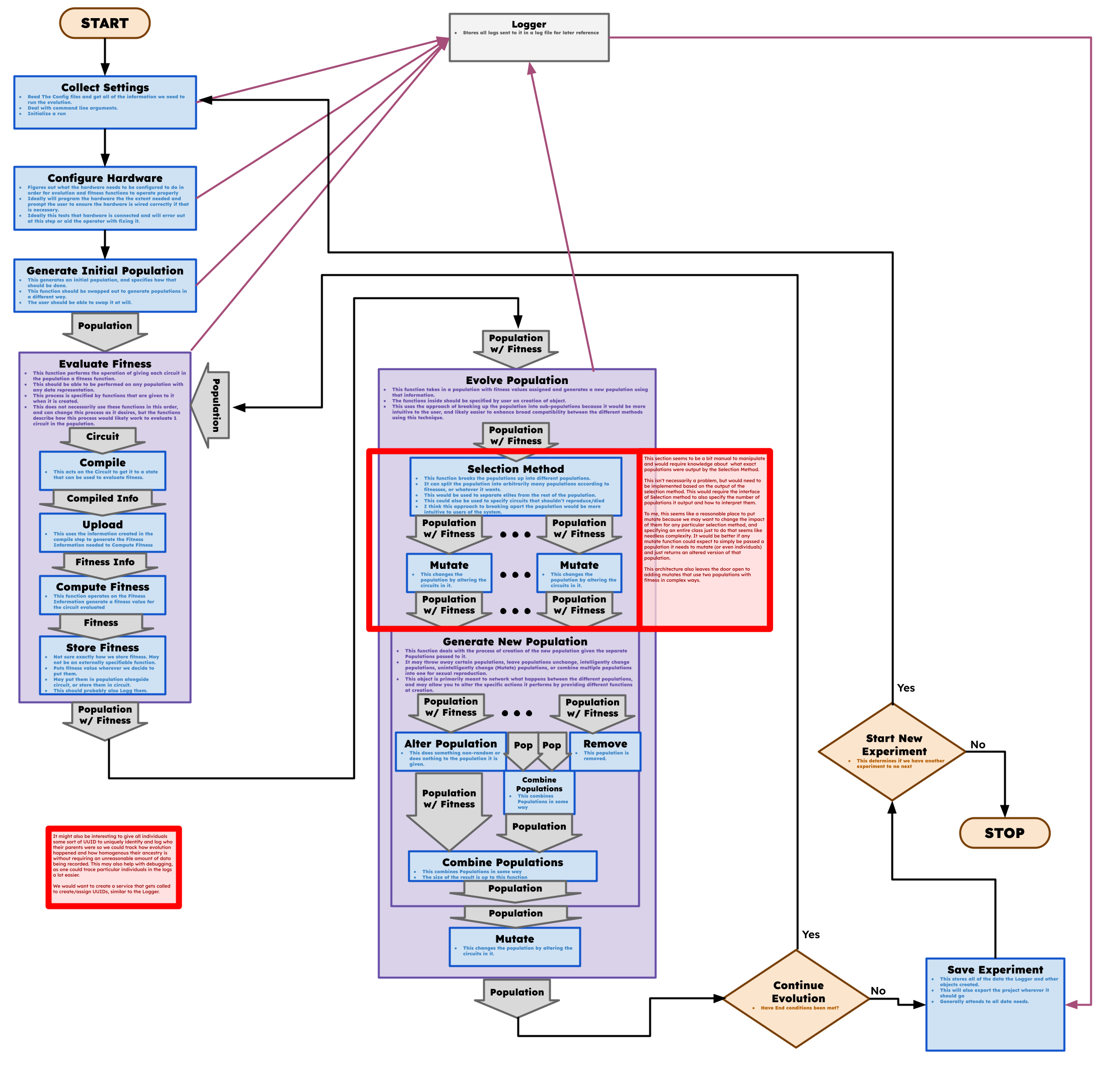
This page documents one of the early attempts at conceptualizing a formal
architecture for BitstreamEvolution, predating the current protocol-based
design. The diagram represents a more procedural, monolithic approach where
major stages were loosely coupled through a shared Logger rather than
through formally defined protocol interfaces.
This architecture was superseded by the initial proposal, which introduced clearer separation of concerns through protocol-based interfaces.
Top-Level Experiment Flow#
The overall experiment lifecycle proceeds as follows. A single run starts with settings collection and hardware configuration, generates an initial population, then repeatedly evaluates fitness and evolves the population until a stopping criterion is met. After saving the experiment, the user can optionally begin a new one.
A Logger object is threaded through all major stages, collecting data
at each step for later analysis.
        flowchart TD
    START([START]) --> CollectSettings["Collect Settings"]
    CollectSettings --> ConfigHW["Configure Hardware"]
    ConfigHW --> GenInitPop["Generate Initial Population"]
    GenInitPop --> Pop["Population"]
    Pop --> EvalFit

    subgraph EvolutionLoop["Evolution Loop"]
        direction TB
        EvalFit["Evaluate Fitness"]
        PopFit["Population w/ Fitness"]
        EvolvePop["Evolve Population"]
        ContEvol{"Continue\nEvolution?"}

        EvalFit --> PopFit
        PopFit --> EvolvePop
        EvolvePop --> ContEvol
        ContEvol -->|"Yes"| EvalFit
    end

    ContEvol -->|"No"| SaveExp["Save Experiment"]
    SaveExp --> StartNew{"Start New\nExperiment?"}
    StartNew -->|"Yes"| CollectSettings
    StartNew -->|"No"| STOP([STOP])

    Logger["Logger"] -.-> CollectSettings
    Logger -.-> ConfigHW
    Logger -.-> EvalFit
    Logger -.-> EvolvePop
    Logger -.-> SaveExp
Evaluate Fitness#
Fitness evaluation processes each individual in the population one at a time. The individual’s representation is compiled into a circuit, uploaded to FPGA hardware, the result is read back, and a fitness score is computed and stored.
        flowchart TD
    PopIn["Population"] --> Circuit["Circuit"]
    Circuit --> Compile["Compile"]
    Compile --> CompiledInfo["Compiled Info"]
    CompiledInfo --> Upload["Upload"]
    Upload --> FitnessInfo["Fitness Info"]
    FitnessInfo --> ComputeFitness["Compute Fitness"]
    ComputeFitness --> Fitness["Fitness"]
    Fitness --> StoreFitness["Store Fitness"]
    StoreFitness --> PopOut["Population w/ Fitness"]
Evolve Population#
Population evolution consists of two sub-stages: a selection-and-mutation phase, followed by assembly of the next generation.
Selection Method: The current population (with fitnesses) is divided into sub-populations. Each sub-population is independently mutated to produce new candidate sub-populations. This allows multiple evolutionary pressures to run in parallel before being recombined.
Generate New Population: The mutated sub-populations are altered (individuals added or removed as needed), then merged and subjected to a final mutation step to produce the next generation’s population.
        flowchart TD
    PopFitIn["Population w/ Fitness"]

    subgraph SelectionMethod["Selection Method"]
        direction LR
        SubPopA["Population w/ Fitness"]
        SubPopDots["..."]
        SubPopB["Population w/ Fitness"]
        MutateA["Mutate"]
        MutateB["Mutate"]
        OutA["Population w/ Fitness"]
        OutDots["..."]
        OutB["Population w/ Fitness"]

        SubPopA --> MutateA --> OutA
        SubPopDots ~~~ OutDots
        SubPopB --> MutateB --> OutB
    end

    subgraph GenNewPop["Generate New Population"]
        direction TB
        AlterPop["Alter Sub-Populations\n(copy / remove entries)"]
        CombinePop["Combine Populations"]
        MutateFinal["Mutate"]
        FinalPop["Population"]

        AlterPop --> CombinePop --> MutateFinal --> FinalPop
    end

    PopFitIn --> SubPopA
    PopFitIn --> SubPopB
    OutA --> AlterPop
    OutB --> AlterPop
    FinalPop --> PopOut["Population"]
Original Diagram#