Tone Discriminator
(This Remains a Work in Progress) Recreating Adrian Thompson's classic tone discriminator remains a long-horizon objective for Bitstream Evolution. The goal is to evolve an FPGA circuit that receives either a 1 kHz or 10 kHz tone and outputs a digital HIGH/LOW classification signal, all without conventional digital logic.
Experiment Snapshot
| Runtime | Population | Generations | Mutation Rate | Crossover Rate |
|---|---|---|---|---|
| ~24 days | 50 | 5000 | 0.001 | 0.7 |
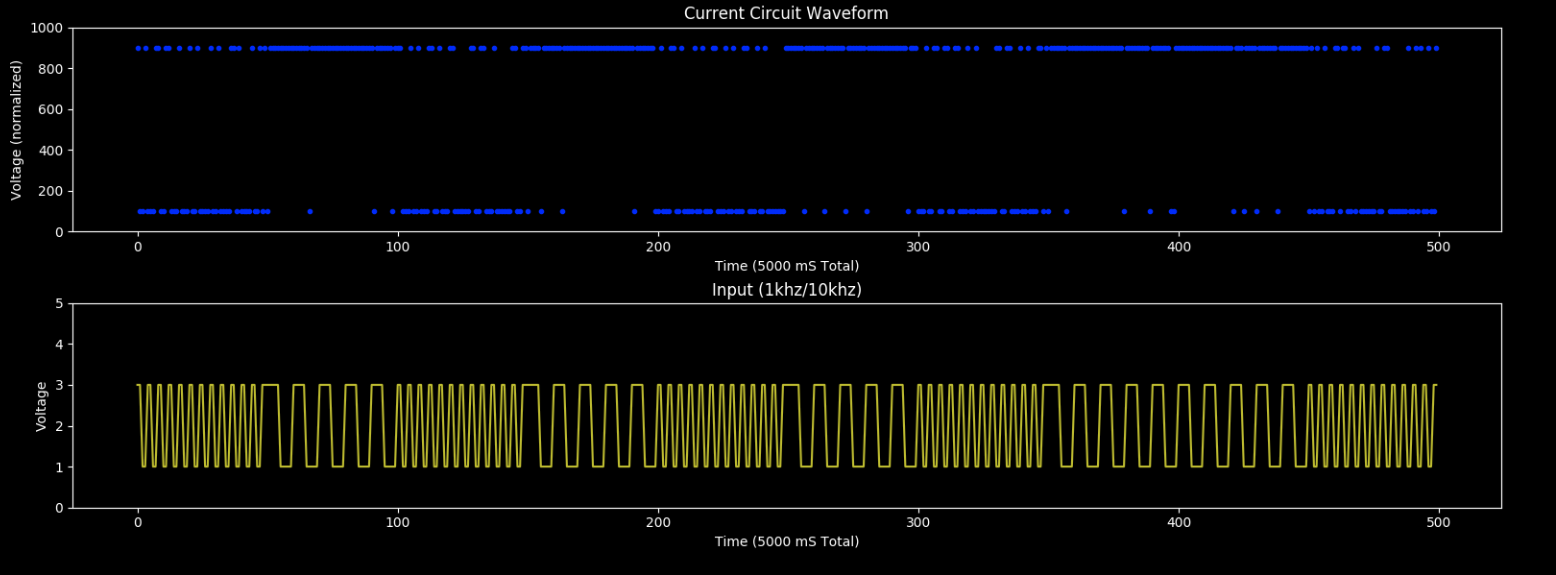
The evolving circuit must output a HIGH signal for 1 kHz inputs and LOW for 10 kHz inputs, despite being encoded directly as FPGA configuration bits without traditional digital logic.
Fitness Function

Two sets of samples are collected—one per tonal stimulus—and summed before taking their absolute difference. Hand-tuned hardware constants $k$ (from Thompson's original work) introduce a slight gradient that guides incremental improvements through the integrating op-amp front-end and into the MCU's ADC readings.
Results
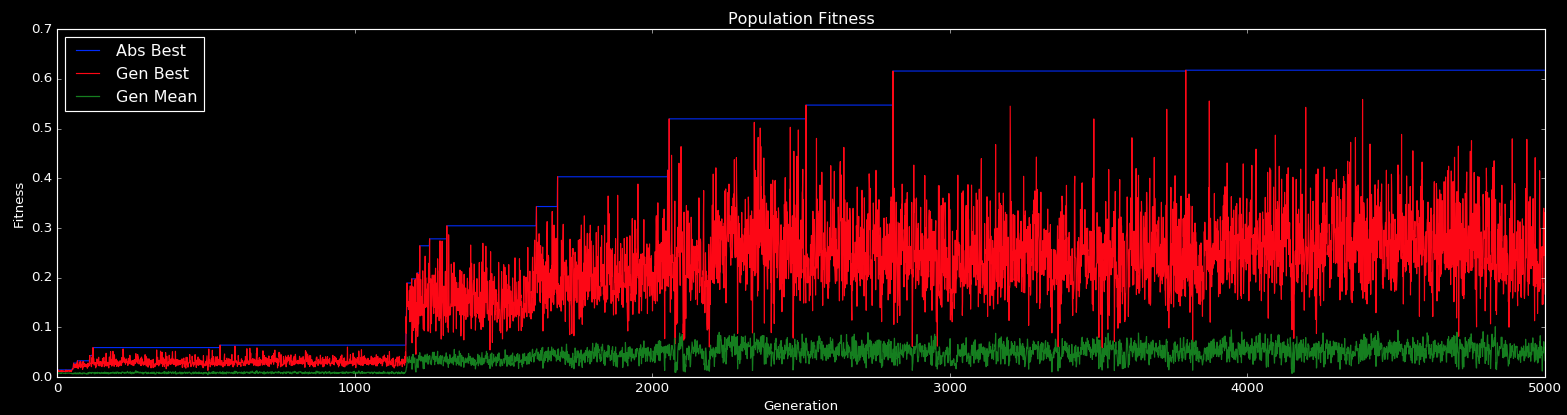
These ultra-long runs tend to plateau for thousands of generations before discovering a new optimum. To date, only low-fitness discriminators have emerged on the iCEstick platform, but observed jumps in both best and mean fitness suggest that continued exploration plus tooling refinements could eventually reproduce Thompson-level performance.