Target Frequency Sweep
In our 2025 paper we benchmarked how quickly oscillatory circuits emerge when they are evaluated against different pulse-count targets. Each run shared the same evolutionary settings (population 50, 6 trials per target, 800 generations aggregated) and differed only in the desired frequency.
Comparative Fitness Trajectories
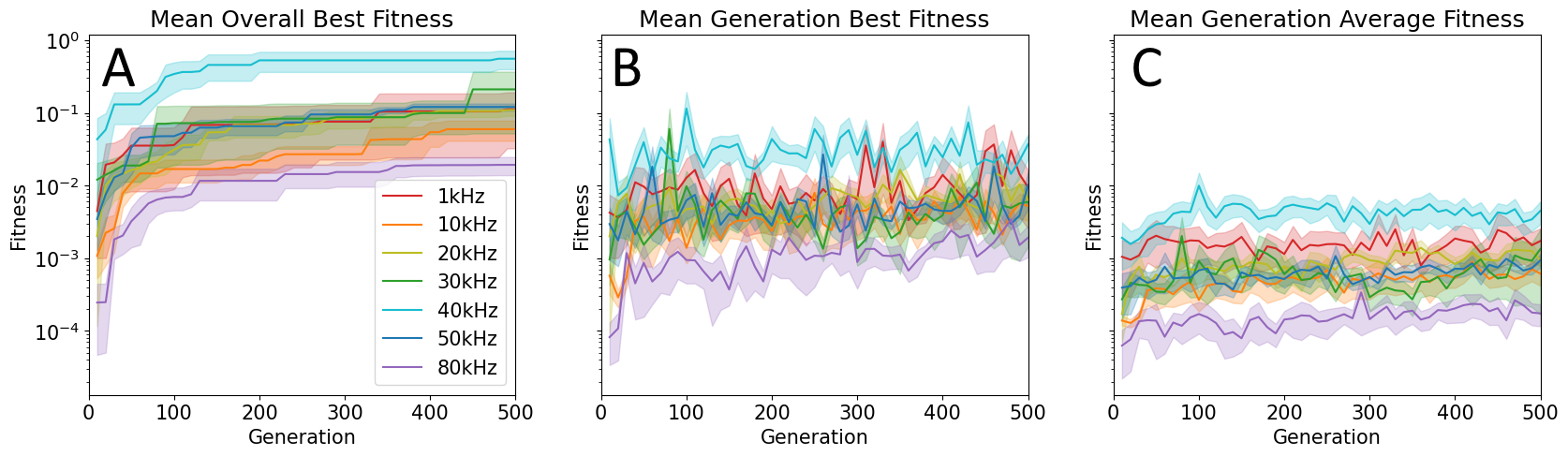
Evolution consistently reaches viable oscillators across the full 1 kHz–80 kHz sweep, but some frequencies are clearly easier to discover. The 40 kHz trials start with a strong random baseline (~40 kHz) and remain ahead in every metric, while the 80 kHz runs trail despite being a simple harmonic of 40 kHz. Lower bands (1, 10, 20 kHz) track closely with 30–50 kHz runs, highlighting that difficulty is not purely correlated with either absolute frequency or its distance from the 40 kHz hotspot. These aggregates mirror anecdotal observations from day-to-day tinkering: certain bands repeatedly “click” on modern iCEstick hardware, hinting that shared noise sources (e.g., the Arduino sampling clock) are providing exploitable structure.
Takeaways
- Evolvability is banded: 40 kHz oscillators reliably outpace all others; 80 kHz oscillators underperform despite being a harmonic.
- Generation-best curves for 40 kHz often match the overall-best curves for other frequencies, implying a denser set of workable bitstreams in that band.
- Because experiments ran on five distinct FPGAs, the shared bias is unlikely to stem from single-board quirks—further instrumentation is needed to isolate the cause.
- Practically, 40 kHz targets make excellent “sanity check” experiments, while 80 kHz oscillators stress-test new firmware or selection policies.